How many AI tools is too many?


In March, BCG’s Henderson Institute published a study that put a name to something a lot of us had been feeling without one. They surveyed 1,488 full-time US workers about how they actually use AI on the job and found that self-reported productivity climbs as people add tools, peaks at three, and falls once they are running four or more at once (BCG / Harvard Business Review, March 2026). Fourteen percent described what the researchers called “brain fry,” a mental fog one worker compared to having a dozen browser tabs open in your head. In marketing and operations the rate ran above 25%. The people reporting it made more major errors, showed more decision fatigue, and were likelier to want to quit. The cost concentrated in oversight rather than use: the reading, fact-checking, and reconciling of outputs from several tools at once.
It is not the only number pointing this way. ManpowerGroup’s Global Talent Barometer, fielded last fall and released in January, found regular AI use up 13 points over the year to 45% of workers globally, while confidence in using technology fell 18, the first decline in worker confidence in three years (ManpowerGroup, January 2026). NBER’s firm-level survey of nearly 6,000 executives across the US, UK, Germany, and Australia found nine in ten reporting no gain in productivity or employment from AI over the past three years (NBER Working Paper 34836, February 2026). Use is accelerating everywhere you look. Value and confidence are not moving with it.
All three studies measure the same gap from three seats: the worker’s head, the wider mood, and the company’s books. None of them says how to close it, which is the part I spend my days on now. So when I sat down with my friend Wissam Kahi last week, it was less of an interview than two operators comparing notes. Wissam spent the better part of a decade getting AI adopted inside large organizations, most recently as a digital transformation executive at United Rentals, and now advises companies on the same problem independently. The way he describes that work, it was never mainly technical. It was behavioral: change management, workflow redesign, and getting people to actually use what got built. “The biggest challenge is getting people to use it,” he told me. “It’s adoption and changing their behavior. That’s where I ended up spending most of my time.” The challenge with AI, put plainly, is not the AI.
3 Takeaways from a Chat with Wissam Kahi
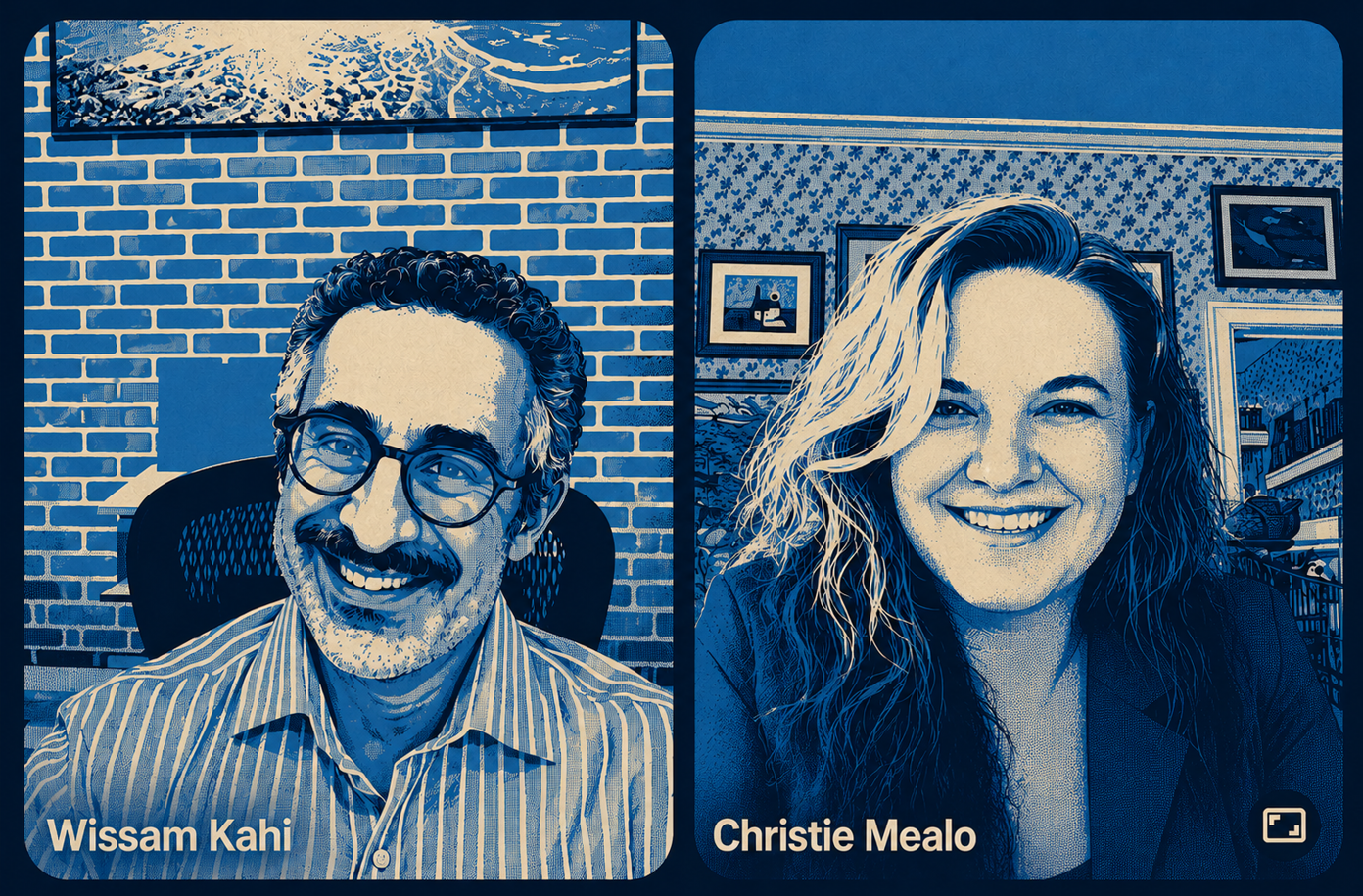
The first is that adoption is a behavior problem, and the people already using the tools well are the ones who can solve it. The move I’m most convinced of, and the one I argue for, is to find that person in each function and give them a hand shaping what everyone else adopts. One per function, close to the work, with a direct line into what gets rolled out. Wissam ran exactly this at United Rentals, and his account of how it worked is the most useful thing in our conversation. “Those were the people we built the product with,” he said. “We’d have weekly calls, show them stuff, and they’d react and say, well, in order for me to use it you need to change this and that. Then we’d change it, come back, tell them to use it, and monitor it: why are you using it, why are you not using it. And eventually you get there.” That is the ManpowerGroup confidence gap, closed by hand, one function at a time. “Those are your key people,” he added, “because they’re typically passionate. They want to do something. If you get them, that’s step number one done, and then the rest can be easier.
The second is that the tools multiply faster than the discipline to manage them. New AI products ship every week, each one easy to adopt and easy to justify, and most organizations end up running more of them than anyone chose on purpose. The BCG data shows why the count matters, with productivity peaking at three tools and dropping at four. What grows with each tool you add is the oversight it demands, since every output has to be read, checked, and reconciled, and that load compounds when several run at once. Six tools used one at a time across a day are manageable; six running at once, all of them needing supervision, are not. The harder discipline is restraint. Deciding what not to add is consistently harder than deciding what to adopt.
The third is the one the research and the conversation kept landing on together. Late in our call, describing how he scopes an AI project, Wissam said, “If you’re not changing your workflow, you’re not extracting the value.” Julie Bedard, who led the BCG study, had told CBS News nearly the same thing, that we need to “redesign how we do our work” rather than keep doing yesterday’s work with AI set on top. A consultant who does this for a living and a researcher who measured it at scale landed on almost the same words. Putting AI on top of existing work generates oversight load. Redesigning the work around AI is what turns it into value. Most companies are doing the first and reporting it as the second.
If you read the first issue, you already know about the 12% of organizations actually seeing measurable returns from AI (PwC, 2026). What separates them, as far as I can tell, is whether the work was rebuilt to absorb the AI or the AI was set on top of work designed without it. The NBER number is what the second version looks like at scale, nine in ten firms over three years with no gain. So when you walk your team’s AI stack tomorrow, ask one question first: is anyone doing their job differently because of any of these tools? The number of tools tells you almost nothing. Whether the work changed tells you everything.
Recap of ProductCon
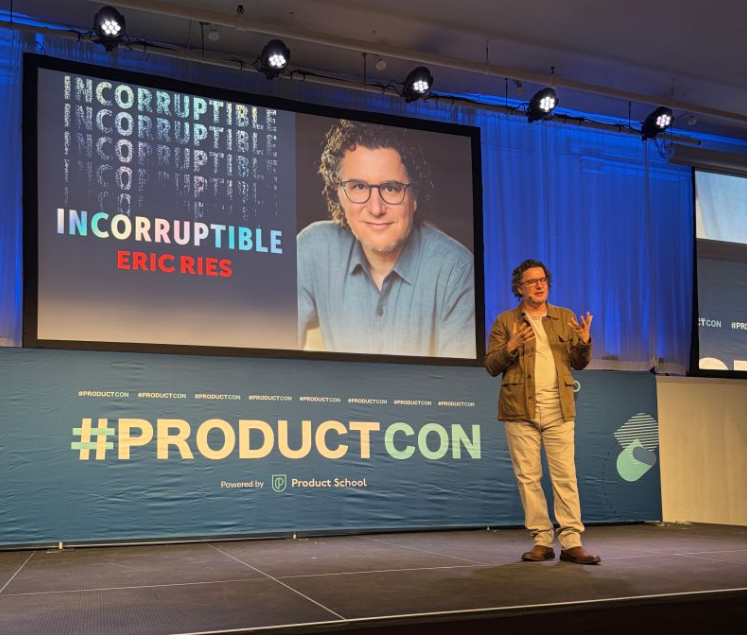
I spent all of May 20th at ProductCon New York. All the talks, slides, and recordings are here: https://productschool.com/productcon/newyork-2026.
The ones that stuck with me:
- Eric Ries, "To Build is a Radical Act." The keynote, and the best talk of the day. Built around his new book Incorruptible, on how good companies go bad. His argument is that corruption is structural, not a few bad actors. Companies built to put shareholders first drift from the customers and the mission that made them worth building.
- Carlos Gonzalez de Villaumbrosia, "The AI Operating Model for Product Teams." Product School's CEO on the gap between teams stuck at individual productivity gains and the top 1% who rewired how they work. The path to AI-native is a J curve, not a smooth climb, and the model has two halves that both have to move: People (PMs as builders, two-slice pods, managers as player-coaches) and System (consolidate the stack, give agents team-level visibility). Most of it is already how we run at MKG.
- Jefferson Rabb, "The Speed Playbook." My favorite after the keynote. The CPO of Business Insider on what happens when engineering stops being the bottleneck and product and process become the new constraint. The shift he named is from a relay race to a basketball game, everyone on the floor at once and roles blurring. The better response is to get chaordic, building leaner processes for systems that won't sit still.
What You Should Read
1. Anthropic's first profitable quarter and the AI IPO wave
cnbc.com/2026/05/20/anthropic-revenue-explosive-growth-ipo-profitable-quarter
Highlights:
- Anthropic is on track for about $10.9 billion in Q2 revenue, a figure that would top all of its sales from last year.
- If Anthropic hits that number, it would mark the company's first profitable quarter.
- Anthropic, OpenAI, and SpaceX are all lining up to go public in the same window.
2. OpenAI starts testing ads in ChatGPT
openai.com/index/testing-ads-in-chatgpt
Highlights:
- OpenAI is reversing its long-stated reluctance on ads, framing the move around funding free access at global scale.
- The ads run only on the Free and Go tiers, are labeled as sponsored, and are kept separate from answers, per OpenAI.
- Conversations stay private from advertisers, per OpenAI, and the pilot began in the U.S. before expanding to other regions.
3. Some ideas for what comes next, May 2026 — Nathan Lambert (Interconnects)
interconnects.ai/p/some-ideas-for-what-comes-next-may
Highlights:
- Lambert argues that 2026 is the first year without a "break" in the ratchet of disruption.
- He writes "minus the hype" as a researcher who tracks the frontier labs closely.
- He connects specific capability jumps to what leaders should actually prepare for.
4. An OpenAI model disproved a central conjecture in discrete geometry
openai.com/index/model-disproves-discrete-geometry-conjecture
Highlights:
- This is the first time a prominent open problem central to a math subfield has been solved autonomously by AI.
- Fields medalist Tim Gowers called the result "a milestone in AI mathematics."
- The model was a generalist, not one trained specifically on mathematics.
5. Almost Nothing Has Changed. Everyone Expects Everything To.
medium.com/@christiemealo/almost-nothing-has-changed-everyone-expects-everything-to-a9df09a6be78
Highlights:
- Across nearly 6,000 executives in four countries, 69% say their firm uses AI (78% in the US), yet 89% report no measurable productivity gain over the past three years.
- Those same executives expect AI to thin their headcount over the next three years, while employees at the same firms expect it to add jobs.
- About two-thirds of the expected cuts come from reduced hiring rather than layoffs, landing hardest on entry-level and first-job roles.
Who You Should Follow
Voices worth following on AI right now, broader than CAIOs: researchers, technologists, and community builders who shape how AI actually gets built and used.
Carly Taylor VP of Concepts Lab at Crunchyroll, ex-Databricks Field CTO for gaming, ex-Activision. With 185k followers, she writes about what actually happens when you ship AI in production, including a sharp recent thesis that the next phase belongs to products built to be used by agents, not humans clicking through onboarding flows. Sharp on careers, sharper on engineering in the agentic era.
linkedin.com/in/carly-taylor-data
Tetyana Yatsenko Data scientist at Comcast and a longtime co-organizer of DataPhilly. Her range across telecom, manufacturing, and finance grounds her read on what actually works across very different businesses, and she is relentless about asking whether a result is true rather than just whether it's an answer. My group, Philly Data & AI, occasionally co-hosts events with DataPhilly, which is how I know her work.
linkedin.com/in/tetyanayatsenko
Eli Goldberg Founder of Measured.One, a data science and measurement practice for payers, medtech, and biotech, and an active healthcare-AI angel investor through Synthio Labs and Springboard Health Angels. Earlier he was VP of Applied Data Science at Current Health (acquired by Best Buy Health), with prior stints at CVS and Novartis. Rare practitioner takes on healthcare AI: that ROI is the wrong question this early, that the data moat is shifting from proprietary data toward real-world longitudinal data, and that AI liability in medicine is still nobody's clear responsibility.
Samrat Kulkarni Founder and CEO of ERaaS Health, after leading clinical analytics at CVS Health. ERaaS runs precision population health at the intersection of weather and health, using conversational AI agents to reach high-risk members ahead of extreme heat and connect them to cooling benefits. Writes about deploying those agents at scale and what precision population health actually looks like in production.
linkedin.com/in/samratkulkarni
Carlos Gonzalez de Villaumbrosia Founder and CEO of Product School and now Product Partners, his new AI consulting firm, and the creator of ProductCon. His AI-native framing, where most companies stall at individual productivity gains while the top 1% rebuild how they work, plus his AI Operating Model (System as the engine, People as the driver, both have to move together), is one of the clearer two-sided lenses on AI transformation I've heard this year.
What’s Moving in Philly
Powered by Kynra.AI — kynra.ai
Five picks for early to mid-June.
Pennovation’s June Open House Wednesday, June 3, 9:30-10:30 AM. Monthly open house at Pennovation. Not a tech event per see, but Pennovation is one of the most reliable startup and research environments in Philly. Tour the Center, meet members, learn about available spaces. Pennovation Center, 3401 Grays Ferry Avenue. kynra.ai/events/623
Claude Code Philly Saturday, June 6, 1-4 PM. Hands-on session for people building with Claude. Prototyping, refactoring, debugging, all skill levels welcome. Tony Siu hosts. Turkish Brew, 1444 N 7th St. kynra.ai/events/610
Find a Cofounder, Help or Join a Startup Monday, June 8, 6-8 PM. Startup Oasis monthly event. Founders pitch, the audience votes, then breakout groups open where you can help, join, or just watch. Free to attend. The Yard, 21 South 11th Street. kynra.ai/events/626
Penn Health-Tech Accelerator Demo Day 2026 Thursday, June 11, 1-5 PM. The annual pitch event from Penn Health-Tech, with Accelerator teams from Penn and CHOP presenting health-tech solutions to a panel of judges. Keynote, pitches, networking, cohort announcement. Amy Gutmann Hall, 3317 Chestnut Street. kynra.ai/events/499
Python for Data Science: 1-Day Professional Training (PAID EVENT) Friday, June 12, 9 AM to 5 PM. Paid hands-on training covering Python, Pandas, NumPy, and Matplotlib for data work. Designed for analysts and people moving into data science. 123 S Broad Street, 15th Floor. kynra.ai/events/277
Research mentioned in this issue
When Using AI Leads to Brain Fry. BCG Henderson Institute via Harvard Business Review, March 2026. Survey of 1,488 US workers; productivity peaks at three AI tools and drops at four or more, with the cost concentrated in oversight rather than use. https://hbr.org/2026/03/when-using-ai-leads-to-brain-fry?giftToken=5792653711780079201815
AI Brain Fry coverage, Fortune. March 2026, Sasha Rogelberg. Accessible write-up of the BCG study with quotes from lead author Julie Bedard. fortune.com/2026/03/10/ai-brain-fry-workplace-productivity-bcg-study
ManpowerGroup 2026 Global Talent Barometer. January 2026. 13,918 workers across 19 countries; regular AI use rose 13 points while worker confidence in technology fell 18, the first confidence decline in three years. manpowergroup.com/en/news-releases/news/global-talent-barometer-2026-ai-use-accelerates-as-worker-confidence-falls-and-job-hugging-takes-hold
NBER Working Paper 34836, February 2026. Firm-level AI productivity data across nearly 6,000 executives in the US, UK, Germany, and Australia; 9 in 10 reported no productivity gain over three years. nber.org/papers/w34836
What Do the Best AI Productivity Reports Reveal in 2026? UC Today, March 2026. Synthesis of the productivity-versus-deployment gap across multiple 2026 studies. uctoday.com/productivity-automation/ai-productivity-reports-2026
Copyright 2026 - Christie Mealo