The Customer of Tomorrow


Issue 10 · September 2026
What this issue will cover
- Why an AI roadmap is not a strategy.
- How to think about tomorrow’s customer, not only today’s pain points.
- Three tools for turning future possibilities into coherent choices.
- Chapter 4 of The Probabilistic Product, now available in early release from O’Reilly.
Syed Hoda, an innovation strategist at AWS, was recently with a CEO and chief product officer who wanted to become an “AI-first company.” For eleven minutes, they described AI in how they built, what they sold, and how the business operated. Syed joked that AWS would welcome the spending, but added, “If I were your customer, I’d say, ‘Hey, remember me?’”
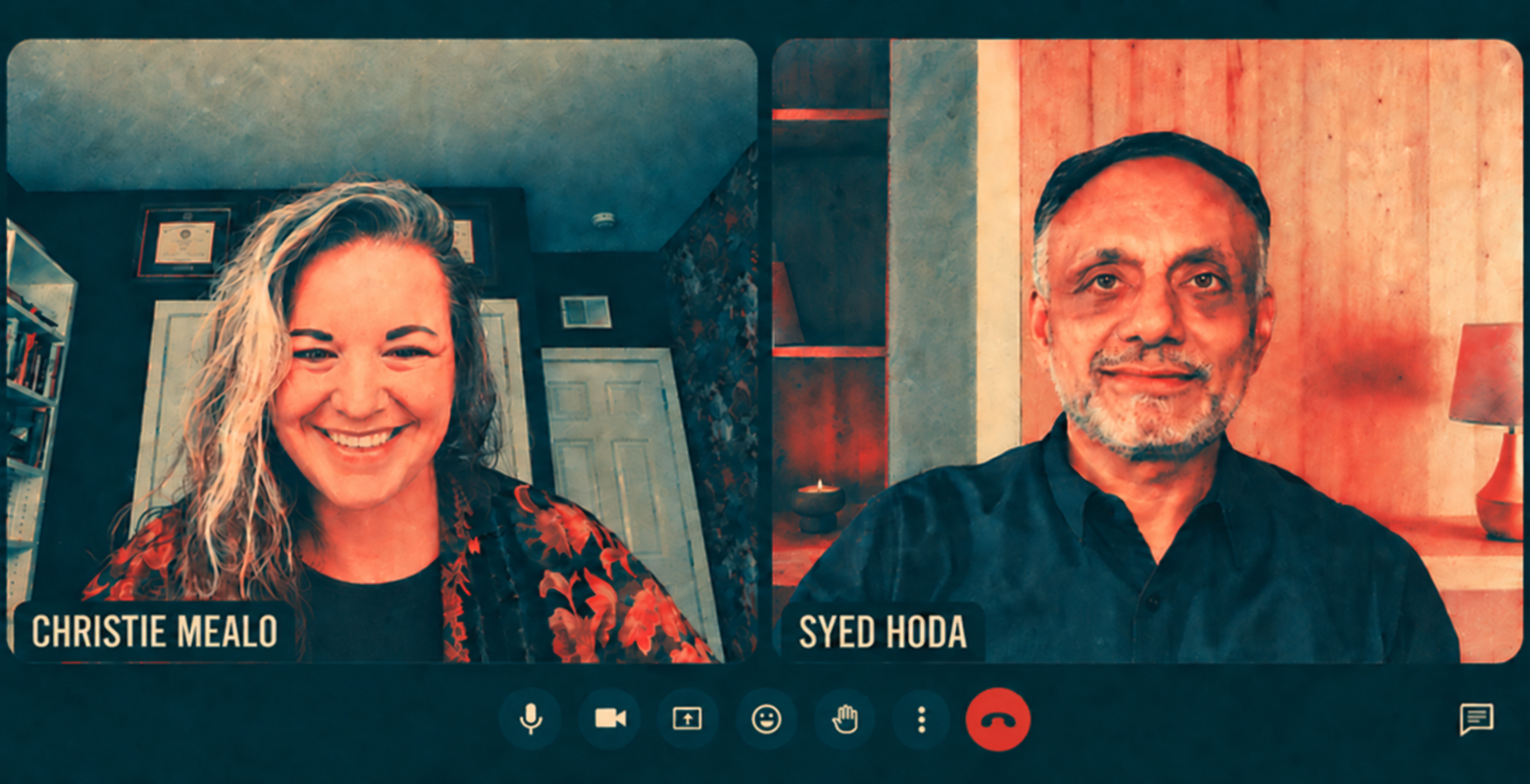
The roadmap contained plenty of AI, but it never explained what would become better for the customer. Every company has to respond to AI, but “we will use AI” is no more a strategy than “we will use the internet.” It says nothing about where to create value, whom to serve, or which future to prepare for.
Syed’s sequence is business strategy first, then AI strategy, then the products, services, and operating changes required to deliver it. Starting with the tool makes it easy to mistake a collection of AI initiatives for a direction, and the better place to begin is the customer of tomorrow.
Good changes
Most companies know what good looks like today because they have customer research, service metrics, and years of operating experience. The harder question is whether those signals describe what customers will value three or five years from now.
Syed used the airport as an example. For his parents, good might have meant a short line and a helpful person at the desk. Today, it can mean never entering the line at all because the boarding pass is on the phone, the bag checks itself in, and the process simply works.
Human interaction was once evidence of good service, but in a better-designed system, needing it may mean something broke.
The same change appears in less glamorous places. I have largely stopped calling my pharmacy because the automated system makes it so difficult to reach anyone, so I drive there for answers. My first instinct is to fix the obvious failures with a smarter bot, shorter menu, or better staffing.
But a good pharmacy experience might eliminate the call and the trip. My doctor sends the prescription, I receive useful updates, and the medication is ready or delivered when I need it.
We may not build that whole experience today, but defining it changes the decisions available. The problem is no longer an inadequate phone tree, but medication access, and the phone call is only one symptom.
That is what makes the customer of tomorrow strategically useful. It asks what people will value after technology, behavior, and expectations have moved, rather than polishing the experience the company happens to offer now.
Faster is not the same as different
In my own day job, much of my attention goes toward operational efficiency, and that work matters. When AI helps a team complete the same work faster, serve more customers, or lower delivery costs, companies have to move toward that standard simply to remain competitive.
Michael Porter’s productivity frontier describes the maximum value a company can deliver at a given cost using the best available technology and practices. GenAI is pushing that frontier outward, allowing more value at the same cost, lower cost for the same value, or something between the two.
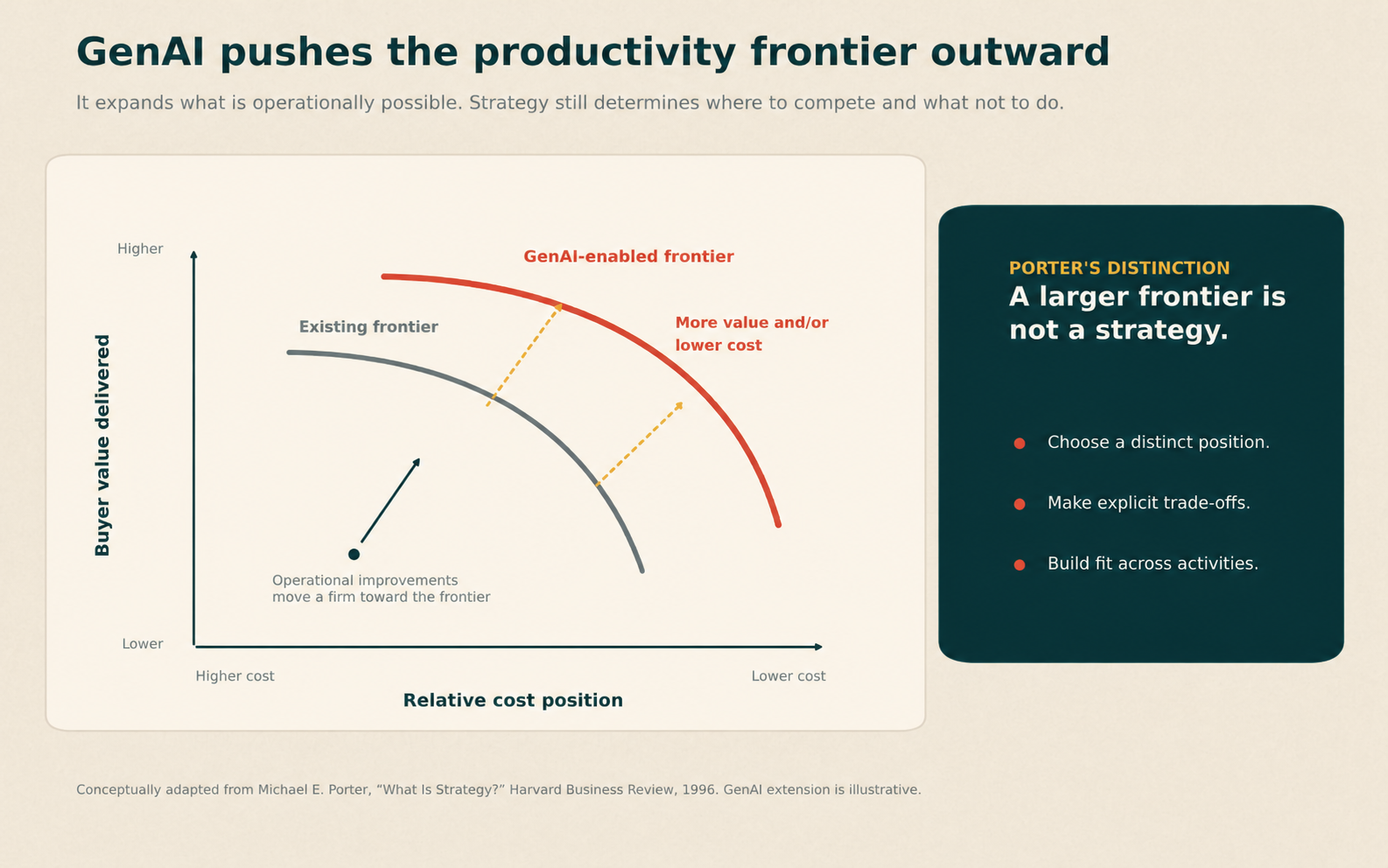
When the capability becomes broadly available, however, the frontier moves for everyone, and an early advantage can quickly become the price of admission.
Porter distinguishes operational effectiveness, which means performing similar activities better, from strategy, which requires a distinct position, explicit tradeoffs, and activities that reinforce one another.
AI can answer pharmacy calls faster, but it cannot decide whether the call should exist. It can help a team ship more features, but it cannot decide which customer problem deserves to be solved or what should stop so the important work has room to move.
Those choices still belong to people, and when everything becomes easier to build, they become more important.
Three tools from my conversation with Syed can help.
1. Write the company’s obituary
Planning usually begins with current products, customers, budgets, and systems nobody wants to touch. That is understandable, but it is also how companies imagine a future that looks suspiciously like the present.
The company obituary begins at the other end. Imagine the company is gone three to five years from now, and answer three questions:
- Who displaced us?
- How did they do it?
- Why couldn’t we respond?
The second question usually reveals three forms of innovation: a better product or service, a more valuable customer experience, or a business model that creates, delivers, or prices value in a way the incumbent cannot match.
Whoever replaces you may remove an irritation the industry accepted as normal, recognize a customer everyone treated as secondary, or do something your economics make difficult.
The third question is the most uncomfortable. “Why didn’t we respond?” looks for a bad decision, but “Why couldn’t we respond?” exposes the system around it.
When Syed ran the exercise with a major retailer, the constraint was simple: the company could not say no. Every request became a priority, so resources were spread too thin for any meaningful response.
Porter famously argued that strategy is choosing what not to do. If every request receives a yes, the organization does not have a strategy, only a queue.
The obituary makes those constraints discussable while there is time to change them. It also reveals what tomorrow’s customer may value, who could deliver it first, and which assumptions may prevent a response.
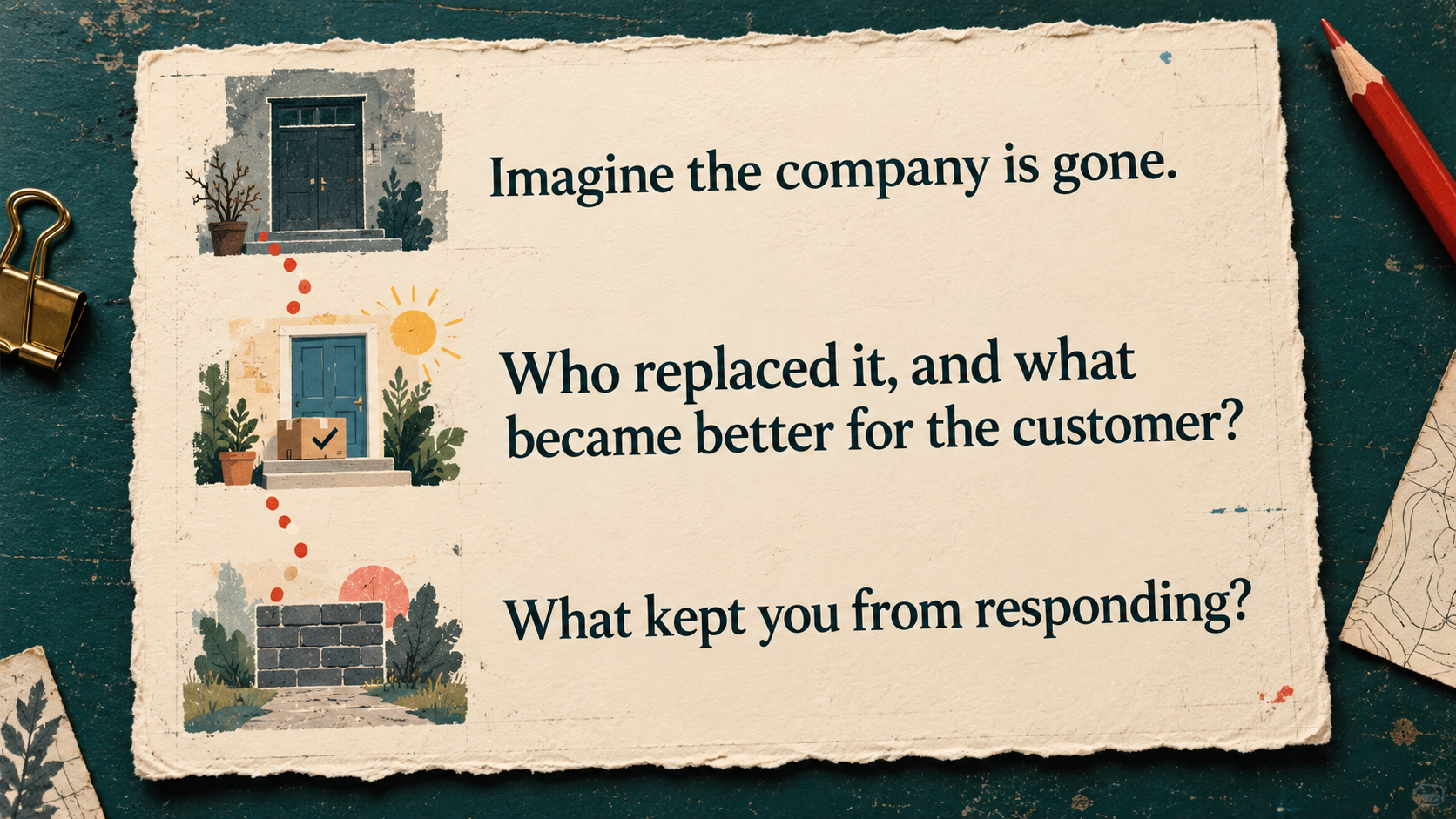
Bain has a public version of the company-obituary exercise if you want to try it with your team.
2. Decide what to Defend, Extend, or Upend
The obituary produces threats, opportunities, and internal constraints, and the next question is what kind of response each requires.
Gartner organizes AI initiatives into three strategic intents:
- Defend: Use AI to improve productivity and remain competitive while the work and workflow largely stay the same.
- Extend: Redesign existing processes, roles, or teams to create differentiation and measurable return.
- Upend: Create new value propositions, products, markets, or operating models.
A Defend investment can be completely worthwhile. If AI helps someone complete an important task faster or with fewer errors, the company may need it simply to keep pace. The trouble begins when a productivity tool is presented as if it reinvented the business.
Extend changes how work moves across a process or team, while Upend asks whether the product, market, or operating model itself must change, even when the current version still produces revenue.
These are not maturity levels, and every initiative does not need to march from Defend to Upend. Most companies need all three, but they do not need Defend work wearing more ambitious labels.
The framework makes the job of each investment explicit. Which work protects the company’s ability to compete? Which work builds a differentiated position? Which bet could redefine the experience or business before somebody else does?
Together, those answers reveal whether the roadmap expresses a strategy or merely records every place someone found a use for AI.
3. Work backward from the outcome
The company obituary looks forward, and Defend, Extend, and Upend set the ambition. Working Backwards connects that ambition to what the company must become capable of doing.
The first step is identifying the customer whose outcome will organize the work, which can be less obvious than it sounds.
Syed described a workshop with a company that made call-center software for insurers. When he asked leaders to name the most important customer, some chose the employee using the software, while others chose the executive responsible for staffing, efficiency, and service levels.
Both answers made sense, but one of the company’s customers interrupted them.
“I realized you guys don’t know who your customer is,” she said.
The vendor had listened closely to users, adding a purple button after one difficult call and a green button after another, until the product became what Syed called a “Frankenstein system,” a record of whatever had frustrated somebody most recently.
The software might reduce a claims call from thirteen minutes to eleven and a half, but the caller still waits, authenticates, and learns the claim remains in process. A proactive update could make the call unnecessary.
The employee is a user, and the executive may be the buyer, but the person waiting for the claim is the customer whose outcome reveals whether the experience is good.
Working Backwards forces the team to define that outcome before implementation.
Based on Syed’s process, the questions are:
- Who is the most important customer?
- What outcome should exist for that customer, without discussing tools?
- What has to happen for that outcome to become possible?
- Which capabilities have to be built?
- How should those capabilities be built, and where does AI materially help?
For the pharmacy, the outcome is not an AI assistant. It is receiving the right medication when I need it, with enough information that I am not left wondering what is happening.
That requires a reliable prescription handoff, responsive inventory and fulfillment, useful updates, coordinated delivery, and a person who can handle exceptions.
Only then should the company decide what belongs in data, integration, workflow design, automation, AI, or some combination. It may not create the entire experience at once, but it can choose the first step based on the future it wants.
Amazon’s public Working Backwards guidance follows the same general principle: describe the customer outcome first, then determine the technical and operational work required to deliver it.
A strategy has to add up
The three tools answer different parts of the same problem:
- The company obituary exposes how the customer, competition, and definition of good may change, along with what could prevent a response.
- Defend, Extend, and Upend clarify each investment’s job and ambition.
- Working Backwards converts the chosen future into outcomes, capabilities, and a path.
No exercise eliminates uncertainty. The customer of tomorrow is still a hypothesis, and strategy does not guarantee the choices will be right. It makes them visible enough to test, fund, revise, or reject.
That is the difference between a portfolio and a pile. A portfolio can contain productivity projects, workflow redesign, and new bets because each has a clear job and reinforces a shared direction. A pile is united only by the technology named in every project description.
AI expands what companies can build and how quickly, but it does not decide what good means, whom it serves, or which future is worth the tradeoffs.
The customer of tomorrow will experience the system you create, not the number of AI initiatives on your roadmap.
Chapter 4 of The Probabilistic Product is live!
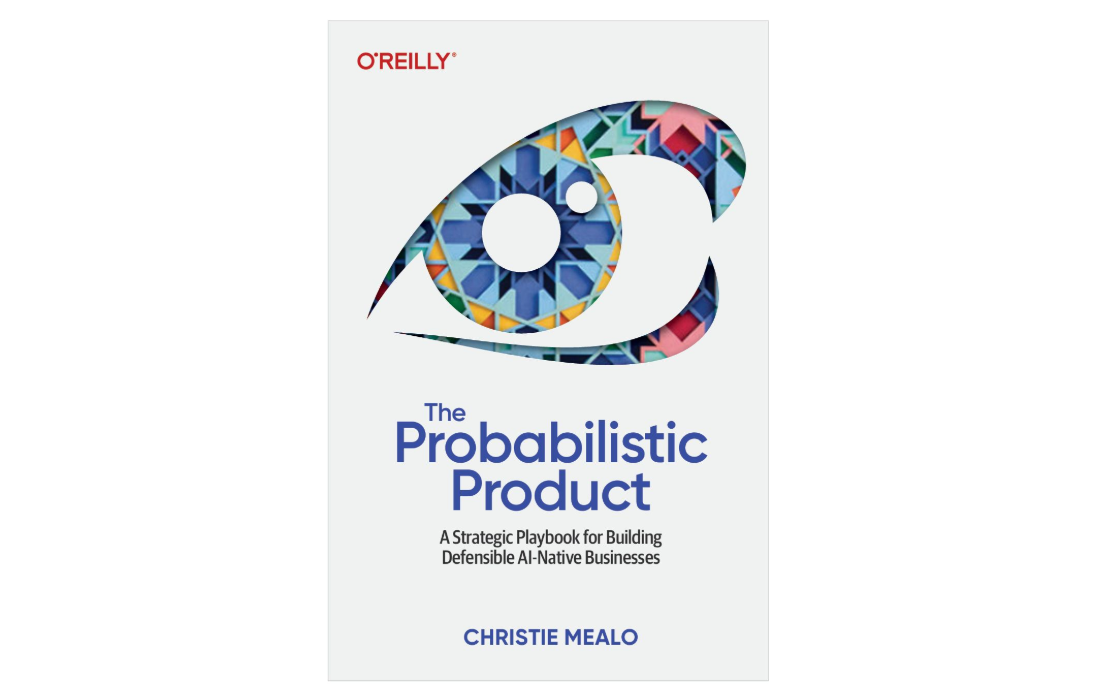
This week, Chapter 4 of my forthcoming O’Reilly book, The Probabilistic Product, became available in early release.
The chapter is called “What AI Product Strategy Really Is.” It goes deeper into the distinction at the center of this issue: AI can move the productivity frontier for every company without choosing a strategic position for any of them.
The chapter develops a fuller system for making those choices: how to Define, Differentiate, and Defend an AI product; why capabilities, differentiators, and moats are not interchangeable; and what must change after strategy leaves the slide deck.
I also share examples from products and transformations I have led, including a paying AI product I shut down because customer demand alone did not make it strategically coherent.
Start your 30-day O’Reilly free trial. Use code LFTPP26.
What You Should Read
The next chapter of enterprise AI is taking shape at the customer edge
PwC, September 10, 2026
Most companies still apply AI one use case at a time. This piece asks what changes when marketing, sales, commerce, pricing, and service are designed around the customer journey, starting with the business outcome rather than the platform.
Designing AI Products and Features: Study Guide
Nielsen Norman Group, September 18, 2026
Tanner Kohler collects practical research on value propositions, real user problems, chat interfaces, scope, and the decisions that should come before adding AI to a product.
Why Canara HSBC Life is rethinking its operating model around AI
Express Computer, September 15, 2026
Canara HSBC Life COO Sachin Dutta explains how the company connects AI projects to business outcomes, customer simplicity, human oversight, legacy systems, and operating-model change.
What we’ve learned from Microsoft’s own AI transformation
Official Microsoft Blog, September 17, 2026
Microsoft began with tool adoption, then shifted toward business outcomes and end-to-end workflow redesign. This first-person account explains what the company learned from its own transformation.
AI made teams faster. Human insight makes the work better.
UserTesting, September 7, 2026
Speed does not tell you whether the work is good. This guide covers customer evidence, human judgment, AI-moderated interviews, and where people still need to stay in the loop.
Who You Should Follow
Syed Hoda
Syed is an Innovation Strategist at AWS whose ideas shaped this issue. Follow him for practical thinking about innovation strategy, customer experience, and operating change.
Tanner Kohler
Tanner is a Principal Experience Specialist at Nielsen Norman Group whose work helps product teams begin with a real user problem before deciding where AI belongs.
Liz Centoni
Liz is Cisco’s Executive Vice President and Chief Customer Experience Officer, leading its move from reactive support toward more proactive, predictive, and personalized service.
Pavel Samsonov
Pavel is a Principal UX Designer at Justworks and writes The Product Picnic. His work asks whether a problem is worth solving before AI helps us solve it faster.
Ariba Jahan
Ariba works across product strategy, customer experience, and AI, and writes and hosts Unmissables. She follows how technology changes customer behavior, expectations, trust, and product choices.
What’s Moving in Philly
AI Builders Night at Cesium HQ
September 22, 2026, 6:00 to 9:00 p.m. | The Curtis Center, 601 Walnut Street, 10th floor, Philadelphia
Coffee & Code Philly brings together local builders for practical talks on AI in products and workflows, followed by networking and final project demos.
Philly Builds AI Founder Series: From Domain Expert to Exit, Building Pequity
September 23, 2026, 5:00 to 7:00 p.m. | Philadelphia; address shared with approved registrants
Pequity founder Kaitlyn Knopp and cofounder Warren Lebovics will discuss turning domain knowledge into a product, reaching product-market fit, and being acquired by ADP. Registration is for Greater Philadelphia product founders and requires approval.
Claude Code vs. Codex: Loops, Graphs, and Harnesses
October 3, 2026, 1:00 to 4:00 p.m. EDT | Turkish Brew, 1444 North 7th Street, Philadelphia
This hands-on pair-programming meetup compares Claude Code, Codex, and agentic coding workflows on real tasks. Bring a laptop and something you want to test. Beginners are welcome.
Philly AI Summit: For Adults
September 26, 2026, 12:00 to 3:30 p.m. | CIC Philadelphia, 3675 Market Street, Philadelphia
This afternoon of workshops and live demonstrations is for people who want to use AI in their work, business, or career. The classroom format gives attendees time to try the workflows themselves.
Philly AI Learning Exchange
September 29, 2026, 12:00 to 1:00 p.m. | CultureWorks Greater Philadelphia, 1315 Walnut Street, Suite 300, Philadelphia
This monthly lunchtime exchange helps people in nonprofits, arts and culture, and small businesses use generative AI without an IT team. It is a low-pressure place to compare what worked, what failed, and what remains unclear.
Copyright 2026 - Christie Mealo