Your Model Is Not the Moat

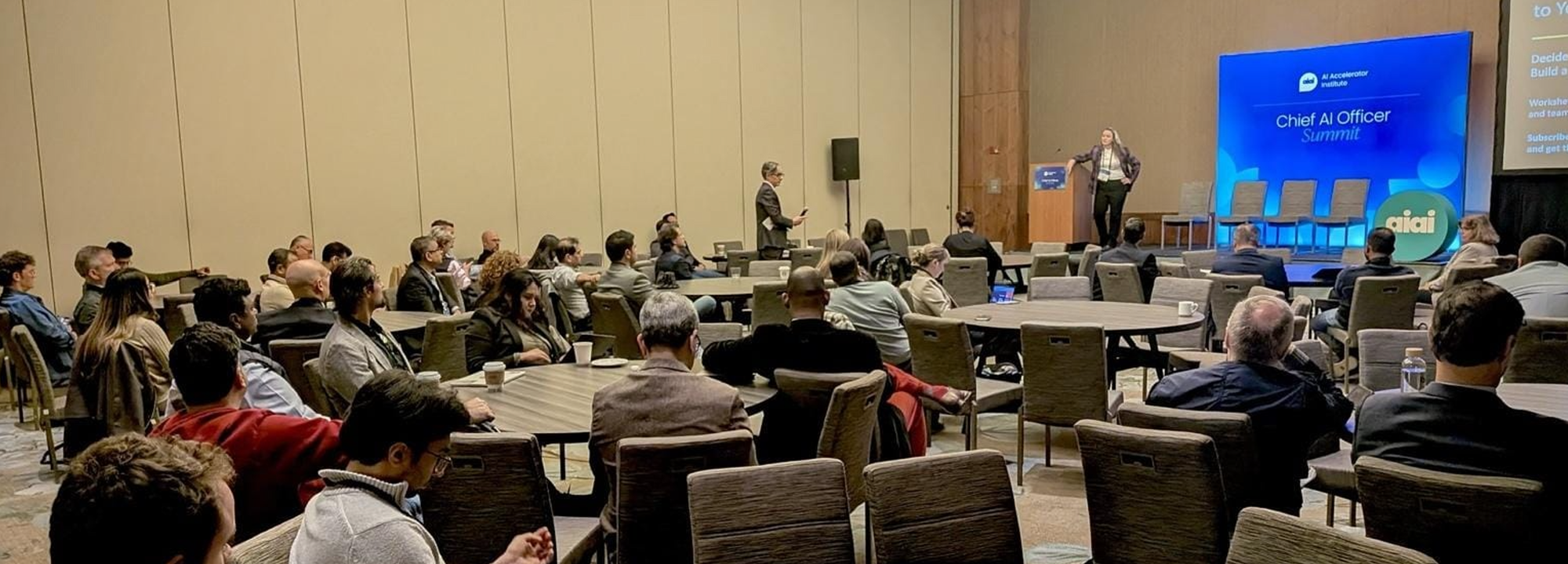
Last Thursday, I gave a talk titled "Your Model Is Not the Moat" at the Chief AI Officer Summit in Boston.
Admittedly, the title is a bit of a misnomer, inspired by examples like Jasper’s early access to GPT-3. Proprietary models can still contribute to a moat when they turn valuable data into outputs competitors struggle to reproduce, but the bigger question is how to decide what’s worth doing now that you can do almost anything.
As Michael Porter famously said, “Strategy is choosing what not to do.” Strategy has always mattered, but AI is multiplying the possibilities and the distractions competing for our attention. This means it's now even more important to know which opportunities are worth pursuing and which to pass up. Similarly, customers are making more choices about what to use, what to ignore, and where to spend their time. In this attention economy, understanding these choices on both sides is critical not only to success, but to survival.
In SaaS, the competition is getting harder. When someone can vibe-code a version of your product in a weekend, why would customers keep choosing yours? In the current landscape, it is essential to look beyond the basic features being replicated by competitors. Identify what your customers truly value, pinpoint the aspects of your offering that they would find difficult to replace, and strategically concentrate our investments to reinforce those core advantages.
Operational Effectiveness is not a Strategy
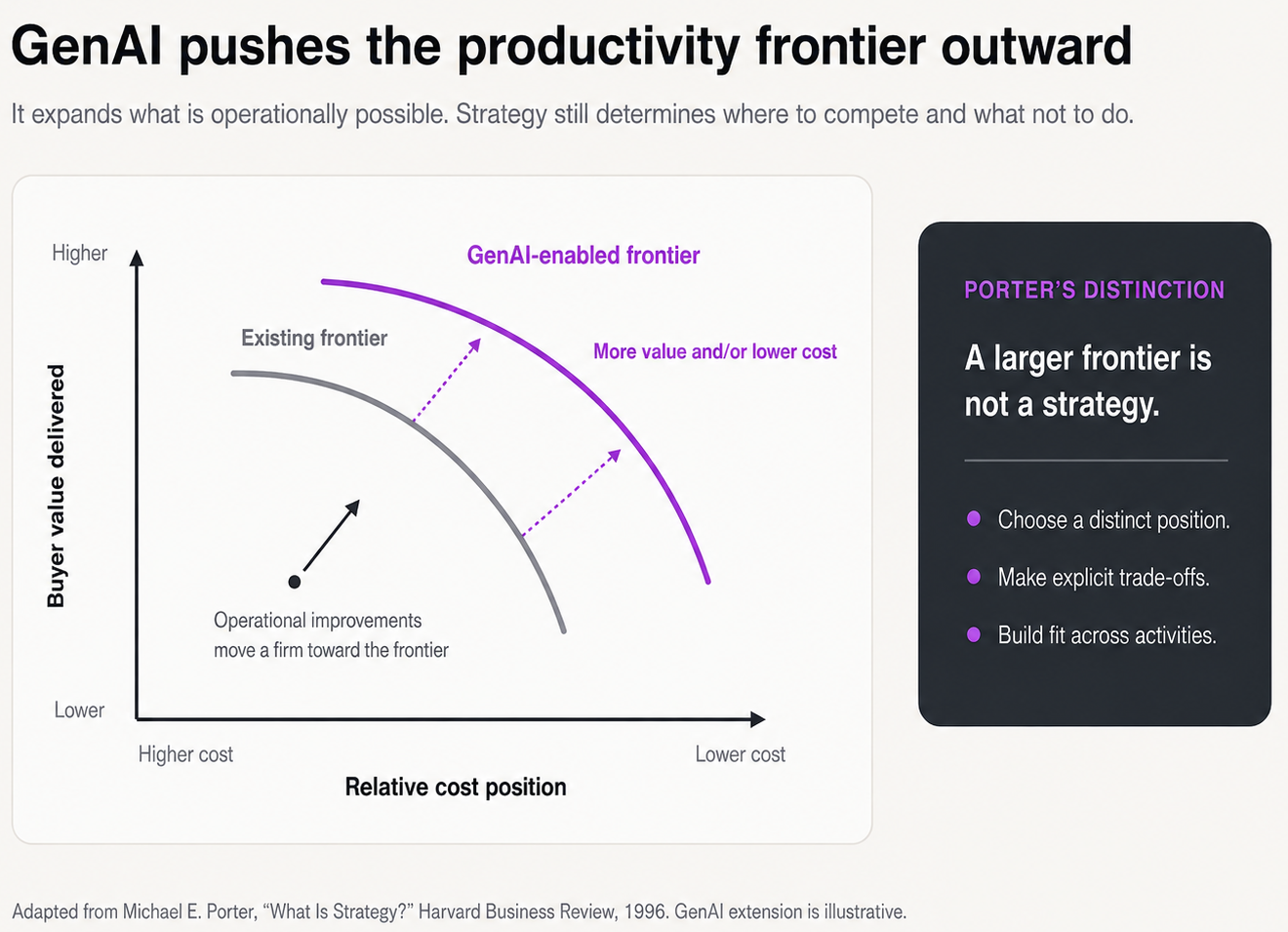
Porter distinguishes operational effectiveness, performing similar activities better, from strategy, choosing different activities or performing them differently. AI makes the difference between the two especially important to understand.
During a technological shift of this scale, improving operational effectiveness is essential to survival. This is the internal work that protects the bottom line: rethinking how teams work, reducing wasted effort, and improving the quality and cost of delivery. Even a business with a strong strategy can fall behind if competitors become substantially better at delivering comparable value.
Strategy is just as critical to the top line and how we compete externally. You have to decide which customers to serve, what to offer them, and why they would choose you over the alternatives. Becoming more efficient does not settle those questions. As the productivity frontier moves outward, yesterday’s differentiator can become something customers simply expect.
At a previous company, a team I was on built a generative AI tool that let clients ask questions about PDFs we produced. It worked, and someone wanted to pay for it. Then came the request to let clients upload their own documents.
That request changed what we would have to support. Customers’ own documents brought requirements for storage, access permissions, security, quality controls, customer support, and ongoing maintenance. We were considering a separate software product, with all the responsibilities that came with it.
We kept the capability inside an existing offer where it added value and chose not to make it a standalone product. There was demand, but our reason to compete was not strong enough to justify the commitment. Supporting that business would have taken resources away from opportunities where we had a stronger advantage.
Capability, Differentiation, and Defensibility
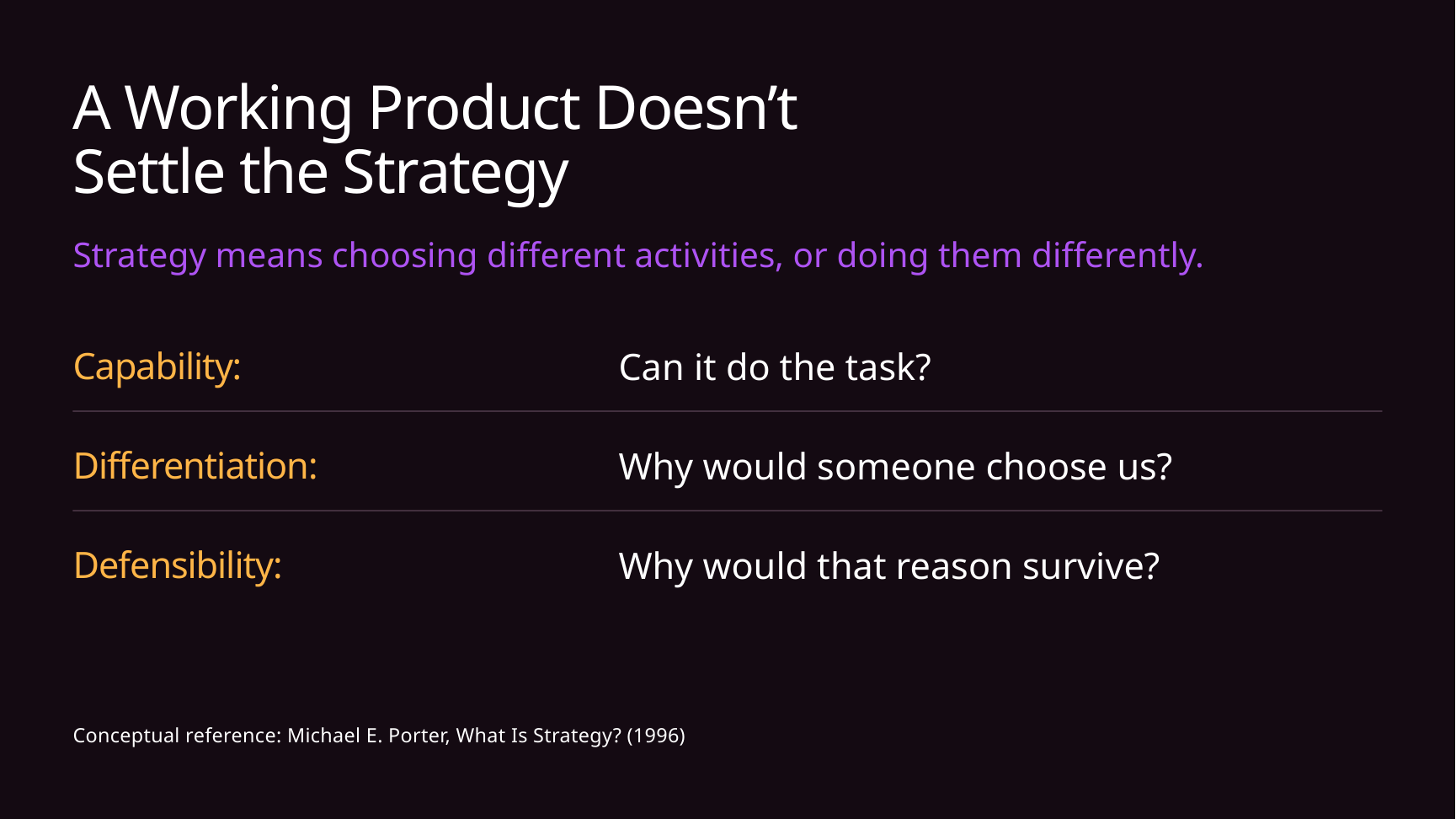
It's helpful to separate three questions:
- Capability: Can we deliver the outcome?
- Differentiation: Why would a customer choose our offer?
- Defensibility: What makes that advantage difficult to match over time?
A working prototype demonstrates capability. An interested buyer signals demand. We still have to establish why that buyer would choose us over the alternatives and what would sustain that preference as competitors improve.
For differentiation, I look in five places.
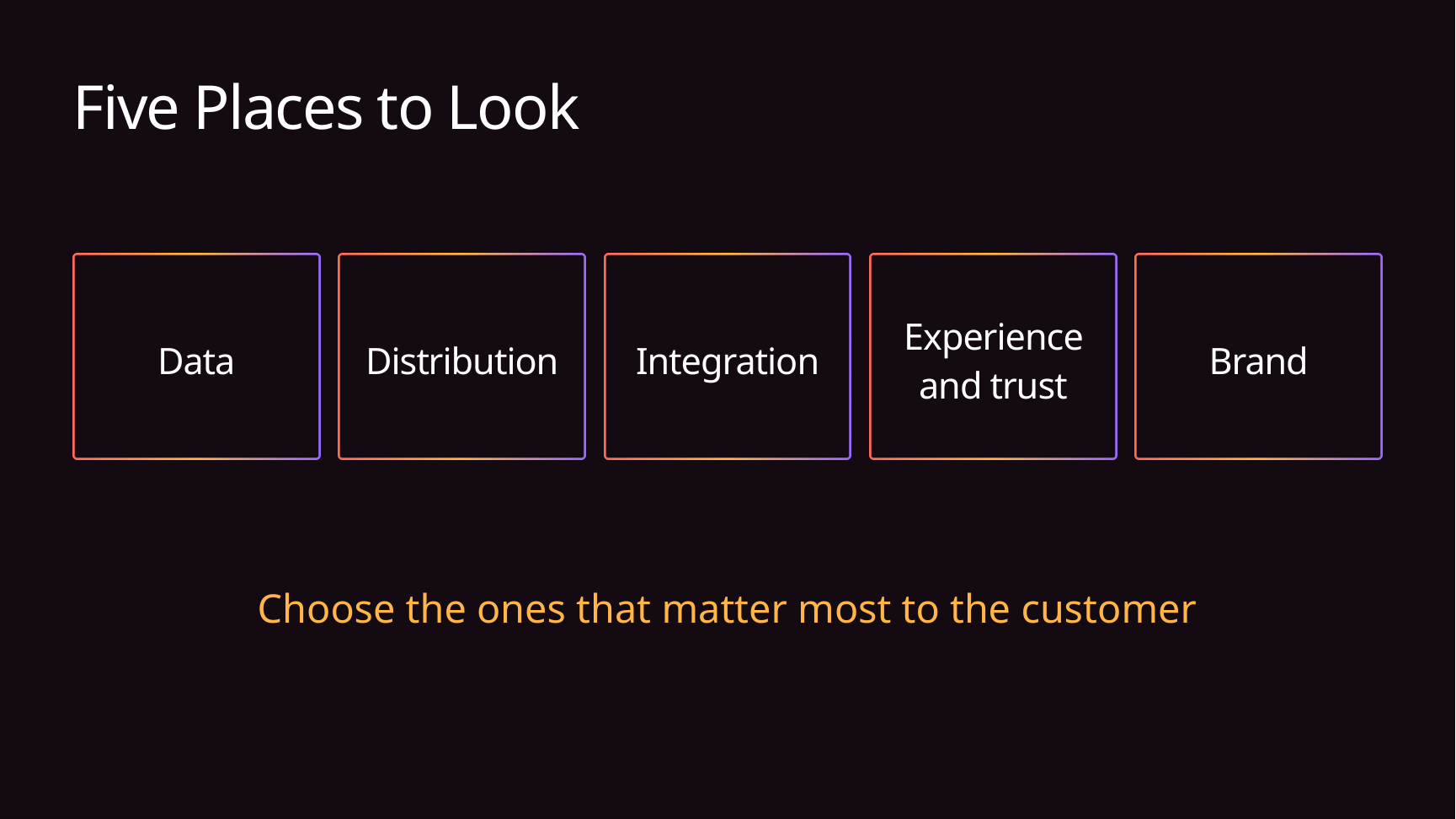
Data matters when it gives us information that changes the outcome. A record showing that an A1c test was billed is of little use if the decision depends on the numerical result. Having a large dataset does not guarantee that we have the particular information we need.
Distribution determines how customers find us and how we continue to reach them. Midjourney’s use of Discord brought access, creation, and discovery into a shared environment, where people could encounter the product through others' use.
Integration determines how well a product fits the work people already do. Claude working inside PowerPoint reduces the need to export a deck, upload another copy, reconstruct the context, and move the result back.
Experience and trust determine whether people can confidently finish the work. Gamma initially felt like magic, turning an outline I’d made with ChatGPT into a visual presentation in minutes. I used it heavily for about a year, then less as alternatives improved. For this talk, I returned for its distinctive output, struggled with the newer editing experience, and finished the deck elsewhere. The initial magic did not make up for the difficulty of finishing the work.
Brand shapes what customers expect from the next purchase. My husband religiously wears his favorite Costco sweatshirt even though we do not have a Costco nearby. He goes out of his way to order from them. Before he evaluates an individual product, he already expects what buying from Costco will mean.
These differentiators are not a checklist to be filled in; you don't even need to invest in all five. Strategy requires choosing which advantages matter most to your customers and organizing the business to deliver on them.
Why People Keep Choosing You
A differentiator gives people a reason to choose you today. Defensibility depends on how well that reason holds up as competitors improve. Continued use is encouraging, but we need to understand what makes our offer difficult to replace, beyond the fact that a customer has not switched yet.
A competitor does not have to copy your architecture to weaken your advantage. They might deliver an adequate outcome through another model, dataset, or approach. The test is how difficult it would be to replace the value customers get from the whole product.
The strongest advantages often come from how several elements work together. The same ingredients can become an omelet or a soufflé; how you combine and prepare them changes the result. In a business, too, the whole can be greater than the sum of its parts.
Consider integration, useful customer history, and trust. An integration puts the capability inside the workflow, accumulated history makes it more relevant to the next task, and a reliable experience gives people confidence to continue using it. A competitor offering the same headline feature may still struggle to replace the value of that combination.
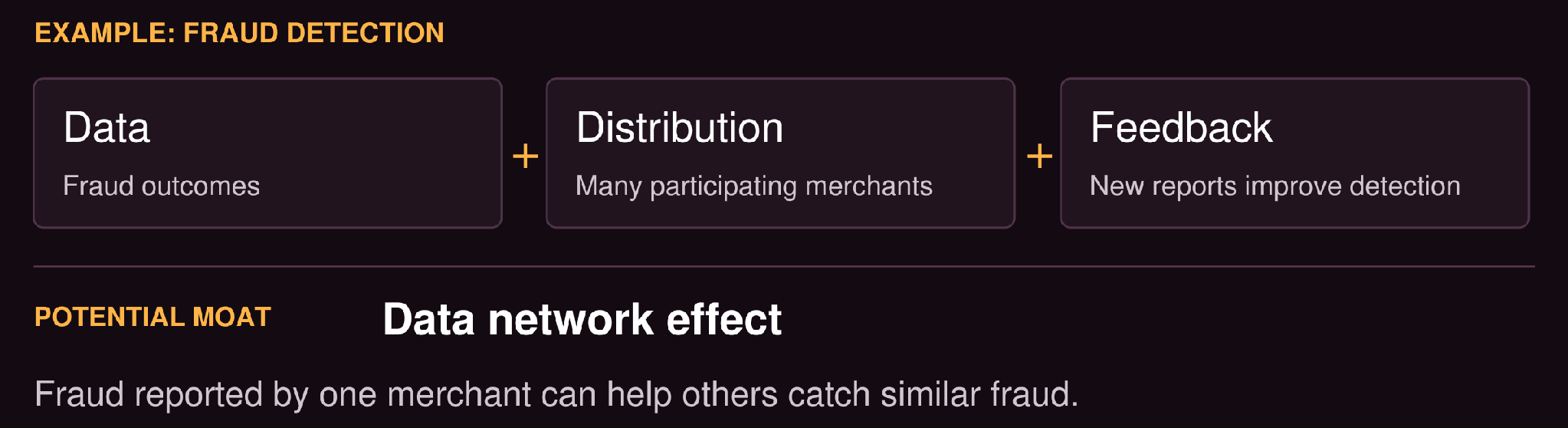
In fraud detection, an outcome observed at one merchant can help reveal a pattern that protects another. When participation produces useful learning across customers, the service can become more valuable to everyone using it. That can create defensibility if a competitor struggles to match the resulting improvement. Simply collecting more data does not establish that the learning is happening.
A community can create value through a different mechanism. Distribution brings people together, but their relationships and contributions give them reasons to return. The advantage depends on what members create together and how difficult it would be to reproduce elsewhere.
Time helps when something useful accumulates. It also creates distance that makes it harder for competitors to catch up. It's important to keep examining what strengthens the customer’s reason to choose you and what could weaken that advantage.
Put the Strategy to Work
For a product or initiative, start with the decision you need to make:
- What outcome are we improving, for whom, and what do they use today?
- Why would they choose us over that alternative?
- What evidence supports our claimed advantage?
- What becomes more valuable through use, and how difficult would it be to replace?
- What will we stop or decline so we can support our priorities properly?
Use the answers to decide whether to invest, change the offer, keep a capability inside an existing product, or stop. Identify what you still need to learn before committing more resources.
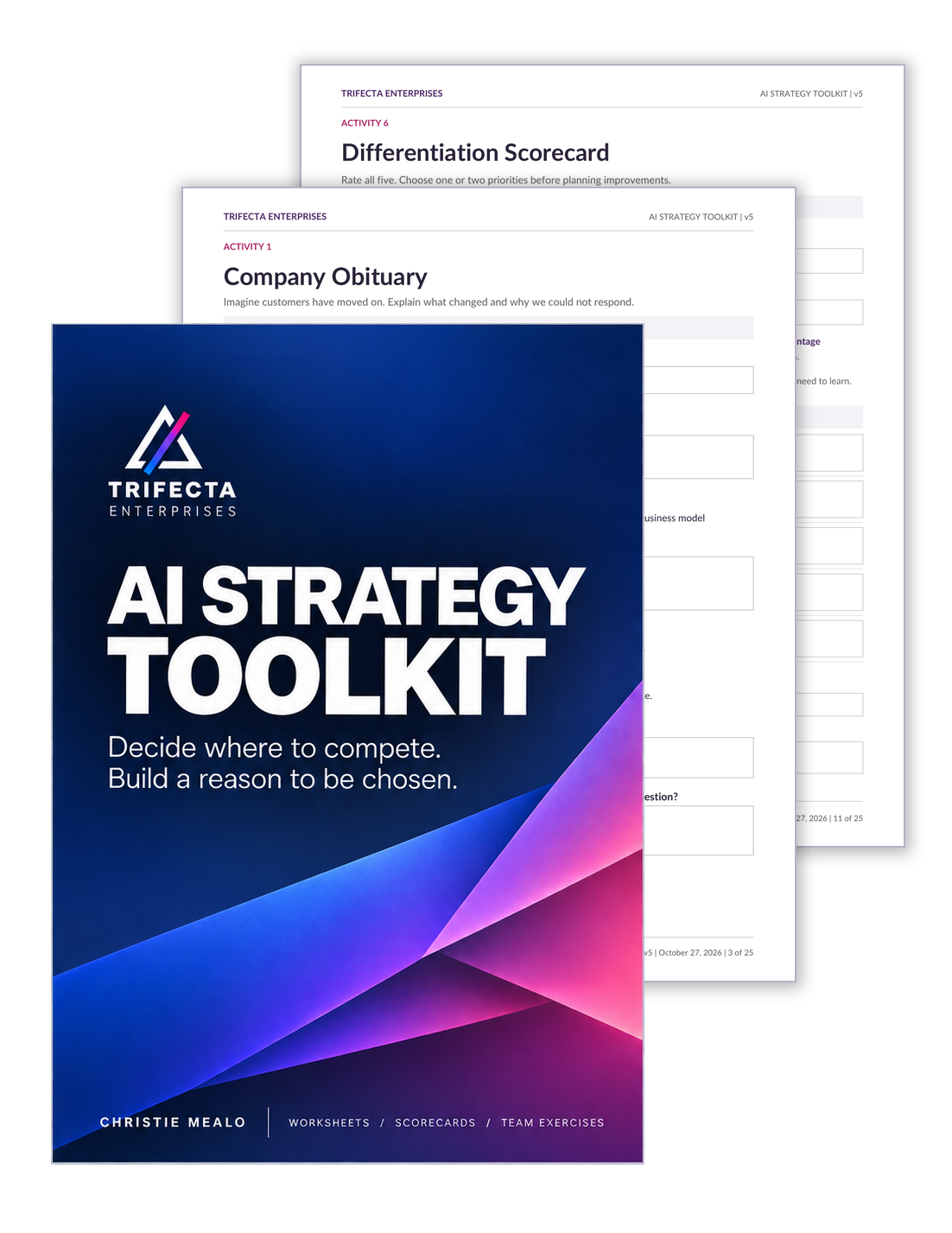
At the company level, the Company Obituary is a useful way to challenge the business you are trying to protect. Imagine that three years from now customers have moved on. What did they choose instead? Why could you not respond, and what warning sign would have been visible today? The exercise can help you decide what to defend, where to extend, and what you may need to upend yourself.
I’ve put these tools into an AI Strategy Toolkit for Superabundance subscribers, with worksheets for company strategy, initiative evaluation, and team prioritization. Use the worksheet that fits the decision in front of you, then agree on the action, who owns it, and when you will review it.
The PDF tool was useful, and we kept it. We also chose not to turn it into a separate, standalone product. As AI expands what we can build, we need the discipline to make those decisions and follow through on them.
Decide where to compete. Build a reason to be chosen.
What You Should Read
Creating a differentiated AI strategy: How to navigate constraints, elevate growth, and build new moats
PwC · October 19, 2026
A useful extension of this issue: it moves AI strategy beyond tools and use cases toward growth, trust, distribution, data, and the few capabilities a company should own.
Cheap Code, Expensive Confidence
Markus Eisele, O’Reilly Radar · October 29, 2026
AI can make output cheaper while verification, judgment, and confidence become more valuable. Although the piece focuses on software development, the lesson applies much more broadly.
AI’s Next Winners: Signals From Private Markets
Morgan Stanley · October 20, 2026
An investor view of where durable value may form across AI infrastructure and applications, including scaling and competitive moats. Treat it as a useful lens, not a universal forecast.
AI agents are gaining employee-level access. How partners can stop over-privileged automation
Antoine Jebara, ITPro · October 29, 2026
A reminder that a seemingly simple AI feature can quickly become an identity, permissions, ownership, and lifecycle decision. The author is a JumpCloud executive, so read it with that vendor perspective in mind.
As AI Reshapes SaaS, Companies Need Pivot-Ready Pricing
BCG, with Stripe and AWS · October 30, 2026
If agents change how software is used, pricing and packaging cannot remain an afterthought. This piece connects product strategy to how companies capture value.
Who You Should Follow
Dan Priest
Chief AI Officer, PwC US
Follow Dan for practical enterprise AI strategy, especially the operating changes required to turn AI investment into measurable value.
Claire Vo
AI product leader and founder, CXO.dev
Claire is candid and practical about building AI products, redesigning workflows, and changing how work gets done inside companies.
Cassie Kozyrkov
Founder, Kozyr; former Chief Decision Scientist at Google
Cassie helps leaders think more clearly about choosing goals, defining value, and making decisions before the evidence is perfect.
Laurie Voss
Head of Developer Relations, Arize AI; cofounder of npm
Laurie is a grounded follow for the unglamorous work that makes AI products reliable after the demo, including evaluations, observability, and verification.
Hugo Bowne-Anderson
Independent AI and data-science educator and consultant
Hugo bridges technical practice and accessible explanation, especially around agent evaluation, application building, and testing what agents actually do.

Browse more Philadelphia tech and AI events on Kynra.
Where You Should Go
DataAI Roadshow Philadelphia
November 4 · Philadelphia · Hosted by Securiti-AI, a Veeam company · Approval required
An executive masterclass on trusted enterprise AI, with expert instruction and peer discussion. The registration page says space is limited and attendance is subject to host approval.
Mural Arts Artist Town Hall on AI: Session 1
November 5 · 6:00–8:00 PM · Mural Arts Philadelphia · By Mural Arts Philadelphia
A different kind of AI conversation: artists will share their perspectives and help shape organizational policy for public-art practice.
MedIQ Data and AI Summit
November 7 · 9:00 AM–5:00 PM · Holiday Inn Express Philadelphia-Midtown · By Confliq.ai
For healthcare leaders and technologists working at the intersection of data, AI, and real operational constraints.
The Technology & Branding Series: AI Search & LinkedIn Strategy
November 10 · 8:00–10:00 AM · 466 Germantown Pike · By Ryan Harbinson
A practical session on using AI search and LinkedIn together to increase visibility, build authority, and drive business.
B2B Growth Summit: AI Operations & Strategic Scaling
November 14 · 6:00–9:00 PM · The Back Room, Philadelphia · By Apex Executive Guild
An executive workshop and dinner exploring practical AI workflows, strategy, scaling, and B2B collaboration.