The New Career Playbook


4 takeaways from a chat with Deepti Bahel on upskilling in AI by building
Issue 14 · November 2026
When Deepti Bahel faced a nine-month career pause following a kidney transplant, she didn't just re-enter the job market, she walked into an entirely transformed landscape. More than a decade of experience in marketing and advertising analytics suddenly collided with an economy reshaped overnight by generative AI.
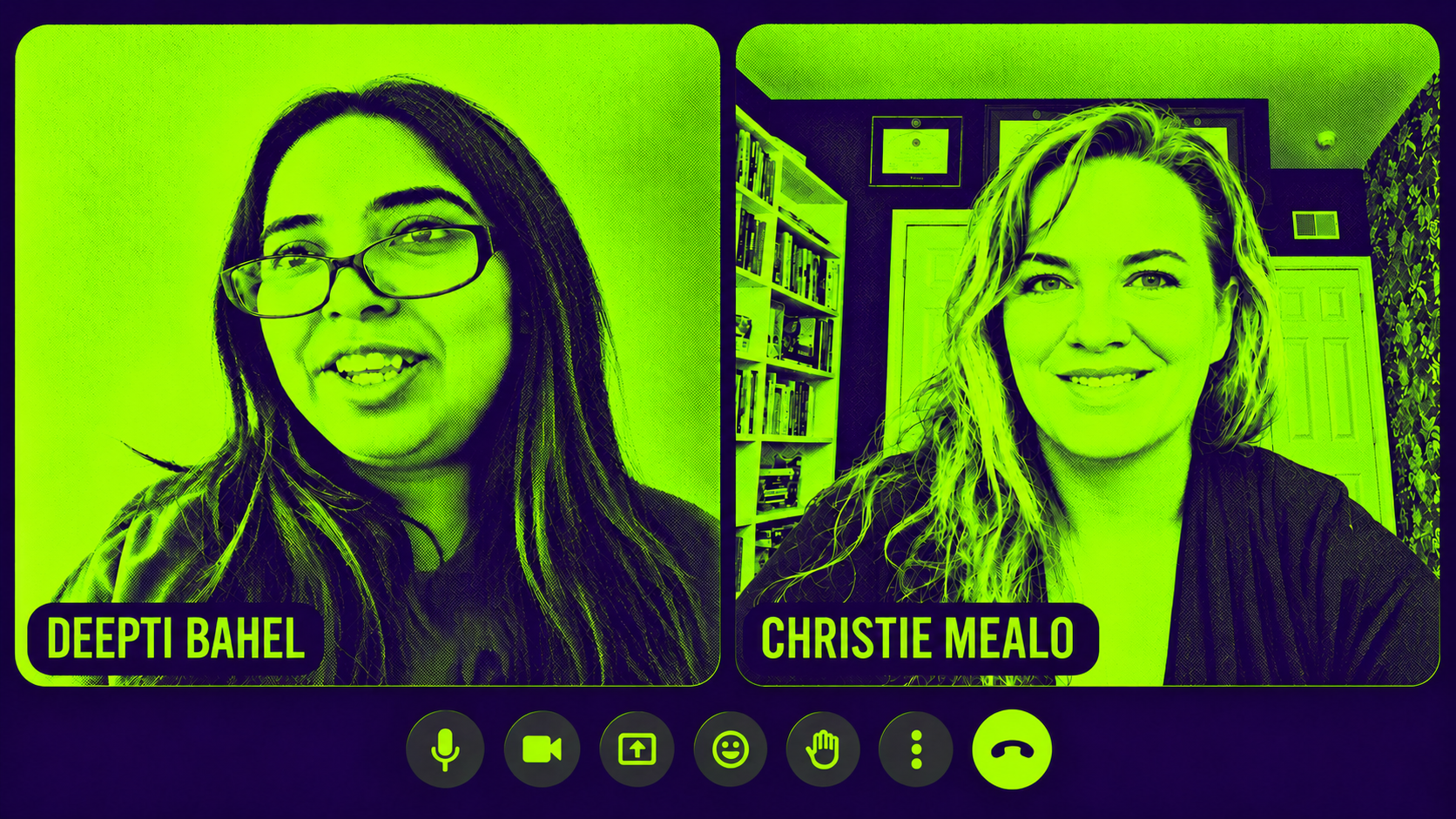
Deepti Bahel and Christie Mealo during their conversation.
During recovery, her firsthand experience as a patient made her question whether she even wanted to return to marketing, drawing her toward healthcare instead. Rather than viewing AI as a barrier to catching up, Deepti treated it as a collaborator. Her move was mainly a change in industry, carrying her Business Intelligence background into healthcare data work by building a project she could test, break, and explain in her own words. That approach ultimately helped her transition into healthcare data engineering, win hackathons, and launch her own nonprofit, the MediMate Foundation.
Whether you’re pivoting careers like Deepti or leveling up in your current job, here is how she approached her rebuild, and how you can use the same playbook to turn everyday AI use into real capability.
1. Start with a problem you actually understand
"Learn AI" is too broad to be a useful plan. Instead of getting pulled into endless courses or new tools, start in an area where you already know enough to spot when the AI gets an answer wrong or incomplete.
- Audit the gap: Deepti spent two days mapping her 12+ years of data experience at companies like Google, Intuit, and Wayfair against the roles she wanted next. She had the technical foundation, but no healthcare project to show how she would apply it in a new domain.
- Use your lived experience: Because of her time as a patient, she understood hospital bottlenecks firsthand—specifically around hospital readmission inefficiencies.
- Inside your current job: You don’t need a career pivot to do this. Pick one recurring headache in your weekly work, like a handoff that takes too long, a messy dataset, or a report that needs heavy review, where you already know what a good result looks like.
2. Build something small enough to inspect
A project doesn't need to be a company-wide transformation. It just needs to be small enough that you can see what happened under the hood. To show she could handle healthcare data, Deepti built a project from scratch in stages:
- The Foundation: She downloaded a public hospital dataset from Maven Analytics and built a Power BI dashboard tracking readmission metrics, getting her hands back into SQL and data visualization.
- The AI Push: Once the core dashboard worked, she asked ChatGPT what else she could do with the project. Using AI as a collaborator, she embedded the dashboard inside a Streamlit application.
- The Upgrade: She expanded the app to include conversational analytics and a predictive layer so users could ask questions of the data directly.
What this means for upskilling: A finished deliverable shows what you and a tool did together, not what you learned. Before you call an experiment done, close the AI tool and explain the choices in your own words. Why did you choose those metrics? Where did you have to correct the AI's assumptions? In interviews, Deepti used her dashboard to walk hiring managers through healthcare terminology and her technical logic—proving she understood the architecture, not just the prompt.
3. Use AI as a daily practice partner
Instead of figuring out the transition in isolation, Deepti used generative AI as a 24/7 sounding board around the project itself:
- Pressure-testing her work: Asking the model to poke holes in her dashboard logic and suggest next steps.
- Mock technical drills: Running simulated behavioral and technical interviews with AI to practice explaining her healthcare project clearly under pressure.
- Translating past experience: Feeding the context of her past marketing analytics work into ChatGPT to help frame her transferable skills for healthcare roles and LinkedIn outreach.
4. Let one small project create the next opportunity
Building something concrete gives you a shared object to discuss with other people, whether in public communities or inside your own company.
- Step into low-barrier communities: Deepti entered her first hackathon using the no-code tool Lovable and built Nourishly, a kidney-friendly recipe and meal-planning app inspired by her own dietary restrictions. Her team won first prize.
- Turn momentum into community: She went on to found the MediMate Foundation, an AI-powered patient and caregiver support nonprofit, and helped organize healthcare innovation hackathons for K-12 and high school students—empowering young patients to build apps for conditions like nephrotic syndrome and thyroid management.
- Bring it to your team: Posting online or joining hackathons isn't the only route. Inside a company, a small experiment gives your team something real to discuss: what worked, what failed, which assumptions changed, and where human review mattered most.
Your 30-day "learn by building" playbook
If you want to build an AI skill this month, try this three-step loop:
- Pick one problem and one skill: Choose a domain or workflow you know well, and pick one specific capability to practice (like using AI to structure a first draft, audit a dataset, or prototype a workflow).
- Decide how you'll judge it—then build: Before prompting, set your standard for accuracy. Use an approved tool to build a small prototype or draft, and keep track of every time you have to step in and correct the output.
- Pass the "explain it" test: Close the tool and explain how you evaluated the result and what you would do differently next time. If your explanation feels thin, that’s the exact skill to practice next.
"You don't need to learn how to code from scratch these days," Deepti says. "You need to know what problem you want to solve... Don't be afraid—we need problem solvers and solution architects."
A finished output tells you what you and a model produced together. What you can explain with the tool closed tells you what you actually learned.
Follow what Deepti is doing (events & communities)
If you want to move beyond prompts and start building alongside others, check out the upcoming workshops, summits, and communities Deepti is involved with:
Upcoming Virtual Events
- Vibe Coding Series — Build Smarter with Claude Code: From AI Prompts to Working Apps: Hosted by Women in Big Data Bay Area with speaker Rachandeep Kaur. Worth checking out if you want a hands-on look at structuring projects with CLAUDE.md, reusable Skills, app architecture, and automated testing. Register on Eventbrite
- Q4 Women in Tech Summit 2026 (Dec 1–4, 2026 | Bonus Community Days Dec 5–6): Deepti is speaking at Girl Tech HQ's virtual summit, which brings together women founders, technologists, and leaders for practical sessions on AI, entrepreneurship, and visibility. Grab a ticket here
Communities to Join
- Women in Big Data: Technical workshops, community events, and networking.
- Girl Tech HQ Community: Connect with women exploring AI, entrepreneurship, and tech.
- Women Applying AI & Women in Data: Global networks and resources for women building and leading with data and AI.
- Connect with Deepti: Follow her updates on LinkedIn, explore her portfolio, or check out the MediMate Foundation.
What You Should Read
Practical perspectives on building AI skills, learning on the job, and adapting work as AI changes it.
Nine engineers, 1,211 pull requests in a day: Lessons from building Copilot Cowork
Bas Brekelmans, Microsoft Command Line, November 2, 2026
A detailed account of how an engineering team changed its practices around AI agents: writing clearer specifications, scoping tasks, building checks that catch real failures, and keeping people responsible for important decisions. Useful for builders and for anyone thinking about how AI changes day-to-day work.
AI Is Reshaping Jobs Task by Task, HRCI Report Says HR Must Lead the Redesign
HRCI Team, November 6, 2026
HRCI lays out eight practical steps for redesigning jobs as AI changes individual tasks. The guidance starts with defining outcomes, involving employees in decisions, training people to use AI responsibly, and protecting career pathways as roles evolve.
LinkedIn data shows where opportunity is emerging as work changes
LinkedIn News, October 27, 2026
A current look at where AI skills are showing up across the labor market, including roles outside technical teams. It is a useful reminder to build skills in the context of the work you already do, rather than treating AI as a separate career track.
AI is giving leaders a new way to build confidence at work
Tiffany Davis, HR Executive, November 9, 2026
A practical case for turning individual experimentation into shared learning: start with manageable tasks, make boundaries clear, and give employees room to discuss what worked and what did not. Davis writes from her role at ADP, and the article’s examples include ADP products.
The U.S. Department of Labor’s Artificial Intelligence Literacy Framework
U.S. Department of Labor, February 13, 2026
A U.S. workforce reference that outlines foundational AI literacy topics and principles for training programs. It includes practical starting points for workers: identify routine tasks, experiment with approved tools, compare the results with your own work, and build role-specific skills. This is an older but useful baseline.
Who You Should Follow
People building, teaching, and thinking about how AI skills develop in real work.
Deepti Bahel
Senior data engineer, AI builder, and founder of MediMate Foundation
Deepti’s healthcare data projects connect technical work with needs she has experienced firsthand. Follow her for updates on building AI and data projects in healthcare and patient support.
Rachandeep Kaur
Software engineer working with AI applications
Rachandeep shares a hands-on perspective on software engineering and AI applications. She is also speaking in the Vibe Coding Series featured in Deepti’s event recommendations.
Amanda Bickerstaff
Founder and CEO of AI for Education
Amanda focuses on AI literacy, education, and practical learning programs. Her work is useful for educators and for anyone thinking about how people can build AI skills responsibly.
Josh Bersin
Founder and CEO of The Josh Bersin Company
Josh writes about workplace learning, talent development, and how AI is changing the skills organizations need. His perspective helps connect individual learning to workforce development.
Konstantin Popovic
Impact3P; strategy and responsible AI
Konstantin shares practical reflections on responsible AI, organizational change, and the effects of AI on work. Follow him for a strategy-focused view of how companies can put AI to work thoughtfully.
Where You Should Go
A few upcoming opportunities to learn, build, and compare notes with people working through AI in practice.
Philly Data & AI Happy Hour
November 17, 2026, 6:00–8:00 p.m. | Con Murphy’s Irish Pub, Philadelphia | Philly Data & AI
An informal gathering for people working in data and AI, people just getting started, and anyone curious. No speakers or slides; drinks are on your own tab.
Intro to AI Series: Do More with AI, Part 2
November 19, 2026, 2:00 p.m. | Parkway Central Library, Philadelphia | Free Library of Philadelphia | Free; registration required
A hands-on session on using AI agents for research, planning, and task automation, with practice in prompting and reviewing AI’s work. No technical background is required.
I Didn’t Ask For This AI
November 28, 2026, 2:00 p.m. | Northeast Regional Library, Philadelphia | Free Library of Philadelphia
A practical digital-literacy session on managing or disabling AI features that appear in everyday apps and devices. Bring a device if you want to follow along.
AI REVOLUTION: Shaping Health Innovation and Intelligent Systems
November 30, 2026, 6:00–7:30 p.m. | Philadelphia Ethical Society | PByPND ISSNAF | Free
A free Philadelphia event on how AI is changing health innovation and intelligent systems. A good chance to hear how people are applying AI in a field where human needs and oversight matter.
Additional Recommended Events
Our friends at Conscious Capitalism New York are hosting “Where have all the values gone: would yours survive a bad quarter?” on December 1. We recommend checking it out. The event runs 6–8:30 p.m. ET at 132 West 31st Street in New York.